Fables & Automobiles

Claude and Codex were used to make the code. I often get asked, “Were they used to make the hero image?”
The story we are told is that they are a Super Intelligence now, so I’m not sure we will ever know…
The Market
Let’s say you are thinking about buying or leasing a new car. And you are token rich. Rather than try to deal with the hot mess that is every scammy middleman or direct website, I asked the robots to build code that would result in a simple HTML page that would house every available car model and style in the US, with all data possible. Make it portable, with all the normal bells and whistles like sorting, filters, search, etc. And make no mistakes.
You end up with this:
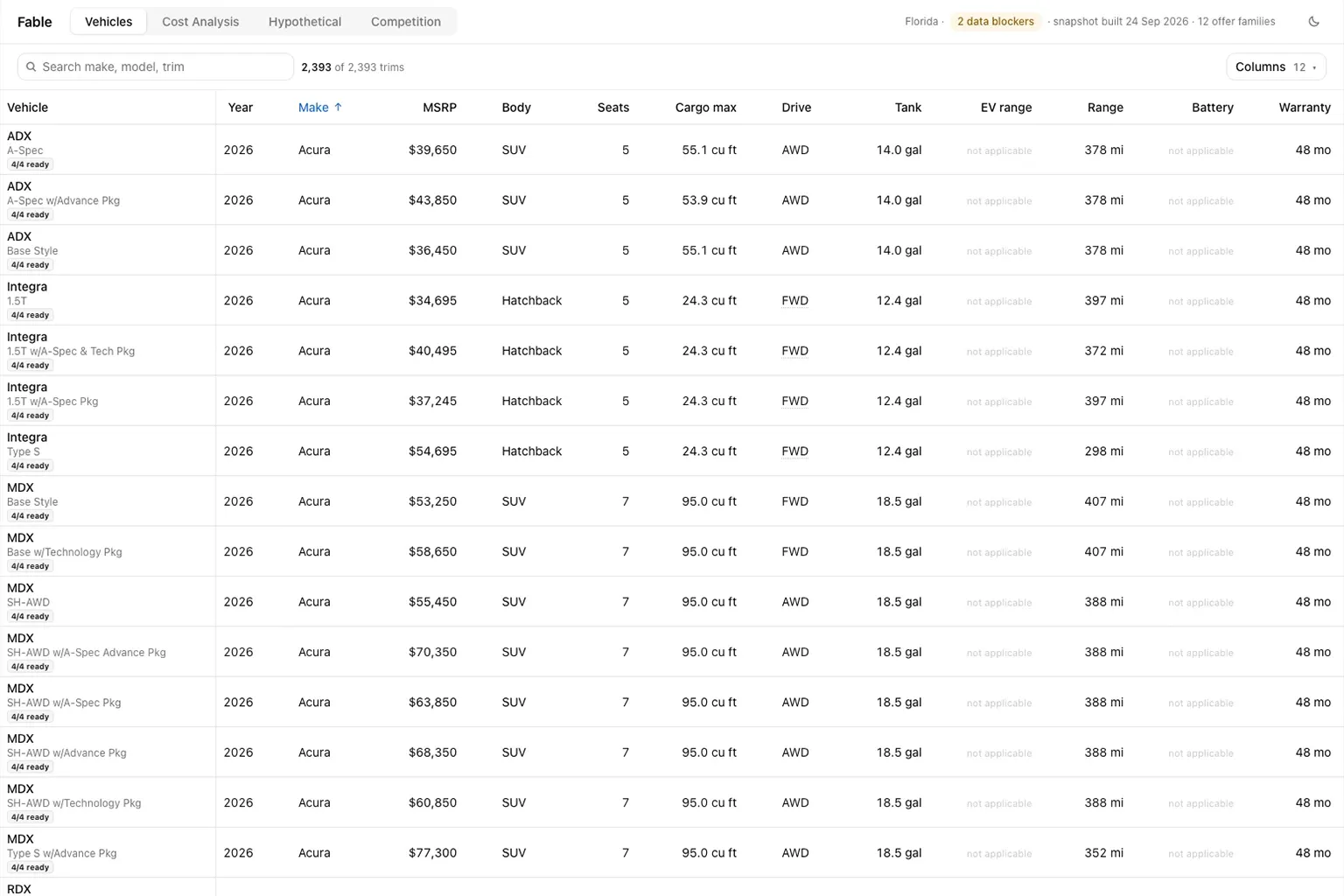
The simple idea was: get a vibe for the market. What do things cost these days? How does one car compare to the rough MSRP of another car? Filter for certain features, add columns, see where the information takes you.
Because the data is sourced from quite a few places, it isn’t perfect and clean, and it does shift over time. Updating the base isn’t as simple as clicking refresh, but both robots are pretty good at making sure the full data set is up to date when needed. The throughline for this entire project is that it’s alllllll fungible and a guess until you sign that legal paperwork. End to end, it’s all just made-up dollars.
After a few rounds, the simple idea turned into a slightly more complex idea: We have the data. Could we determine what a good deal might look like? Could we build an analytical engine to better understand the banks and dealers?
The Math
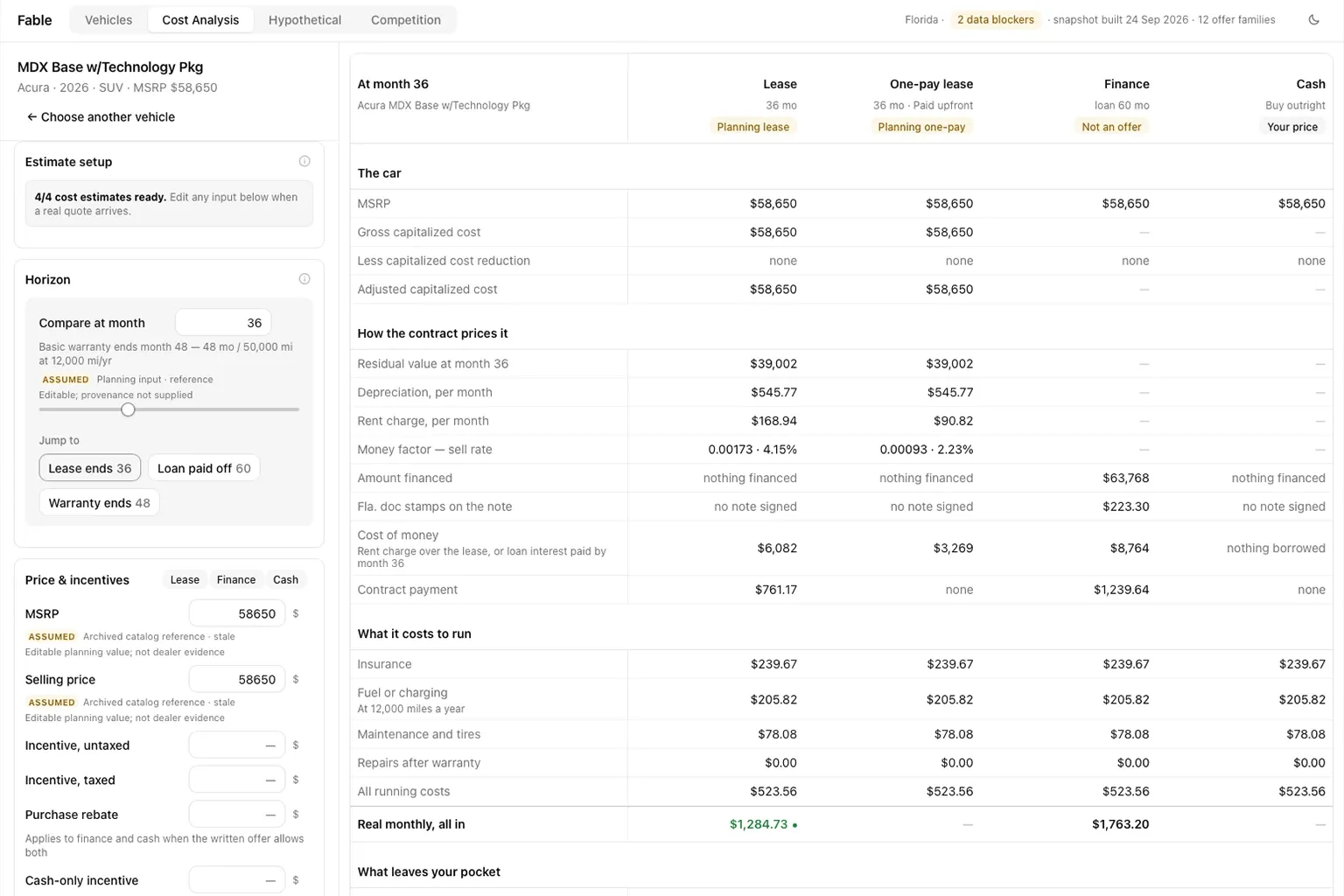
Let’s say you don’t really know if you want to take the finance offer from the website or lease for 24 months. Or you have other questions about finance.
Questions like: What about taxes? What about money factors? How does this all work? What laws apply at the city, state, and federal levels? How do terms work differently between companies? What is needed to build a full picture for a lease, or cash, or finance, or a one-pay lease? What are the exact mathematical formulas used by banks and dealerships or specified in the tax code? These answers can be found in unexpected places. A surprising amount of legal paperwork from lawsuits is available online and easy for agents to gather. Along with normal web search, we were able to build a fairly robust analysis engine.
I also wanted to estimate real-world cost over x months (usually 36 months) on top of the base deal. What goes into real-world costs? Insurance, repairs, fuel, maintenance—anything you can think of. The base data has a LOT of cars, so it needed to be quite flexible to change all the input variables for every type of car. Gas, hybrid, electric, fancy or cheap—it needs to be able to estimate for everything in the research data. If we don’t have it, say so, and give me options to change or tune anything for our assumption soup.
The flow: You start from the first tab and click a car. If there is data available from a manufacturer, it’ll prepopulate the data and load it when you get to the analysis tab. Or you might have seen popular lease/finance websites where people share their negotiation results; we can plug in their data as well to see how that all shakes out across the entire analysis.
The goal here was to disambiguate the “Only $299!” advertisement. In reality, that “deal” had $7,000 down and 48 months of payments with a horrible rate, without all the real-world costs—tax, insurance, fuel, anything else. I needed a better version. A “Here is an idea of what you most likely would pay” version. With the flexibility to compare financial options with any car in the US.
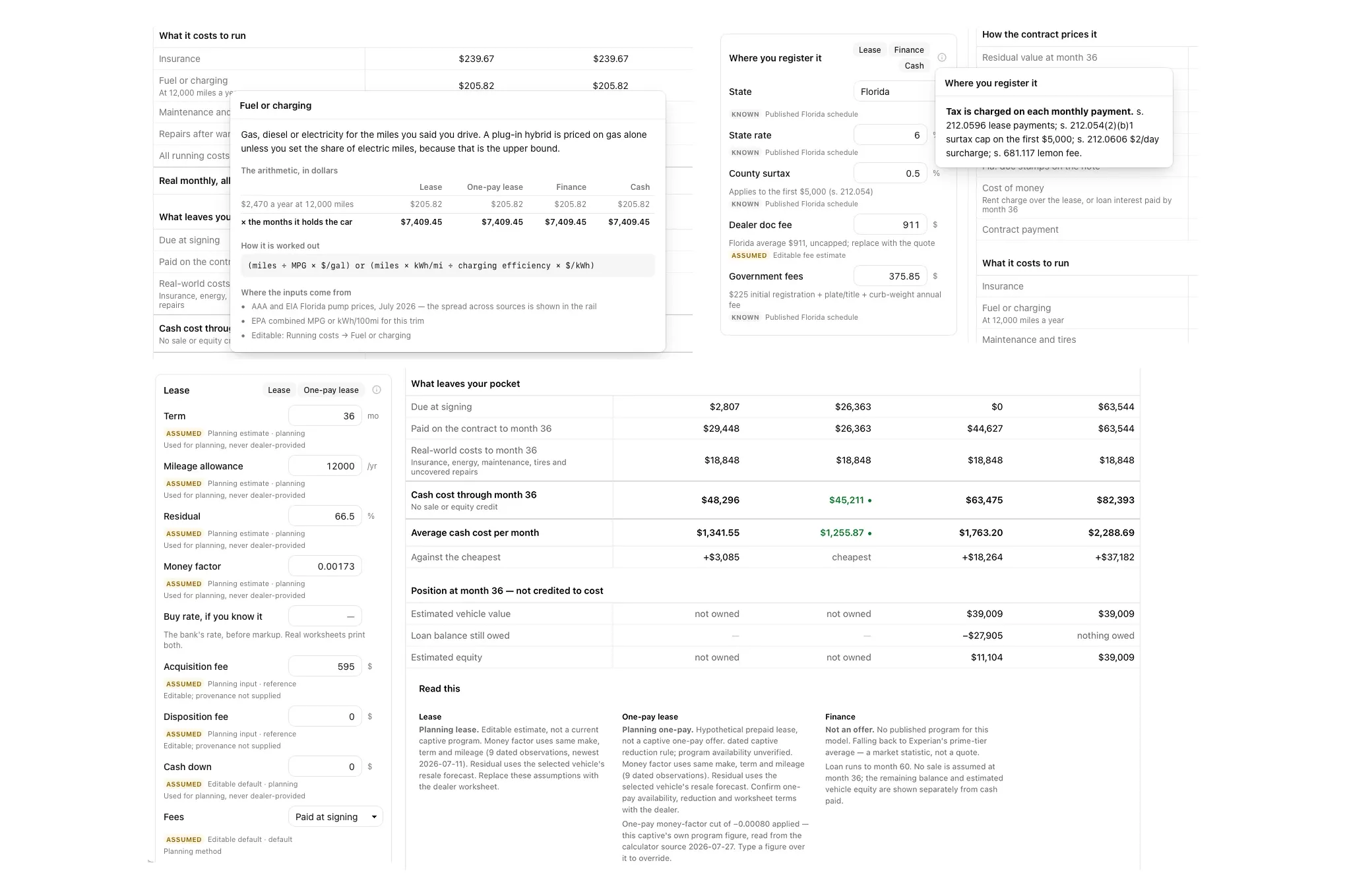
Every single field has popovers that explain exactly the source of the data, as well as the formulas used, the legal details, or why.
The result of this analysis leads to - what would cost the least over time. But again, it’s just assumptions based on research. To get real info, you needed to populate the fields with data from a real deal.
The Hypothetical
If you want to go real deep into the assumption soup, you move into tab 3. The Great Hypothetical Machine. Cars (generally) are depreciating assets. If the goal is keeping the most capital over the longest period of time, what might a solution look like for a specific car? Does that mean you should lease that car every few years or keep the same car longer? How might unexpected pay events impact that decision? How does this look over 3, 6, or 9 years?
This is where you start reallllly laying in assumptions on top of assumptions. You are forecasting out against a lot of unknowns and factoring in variables as if they are constants. But hey, this is all fake money, right? Let’s see where it takes us.
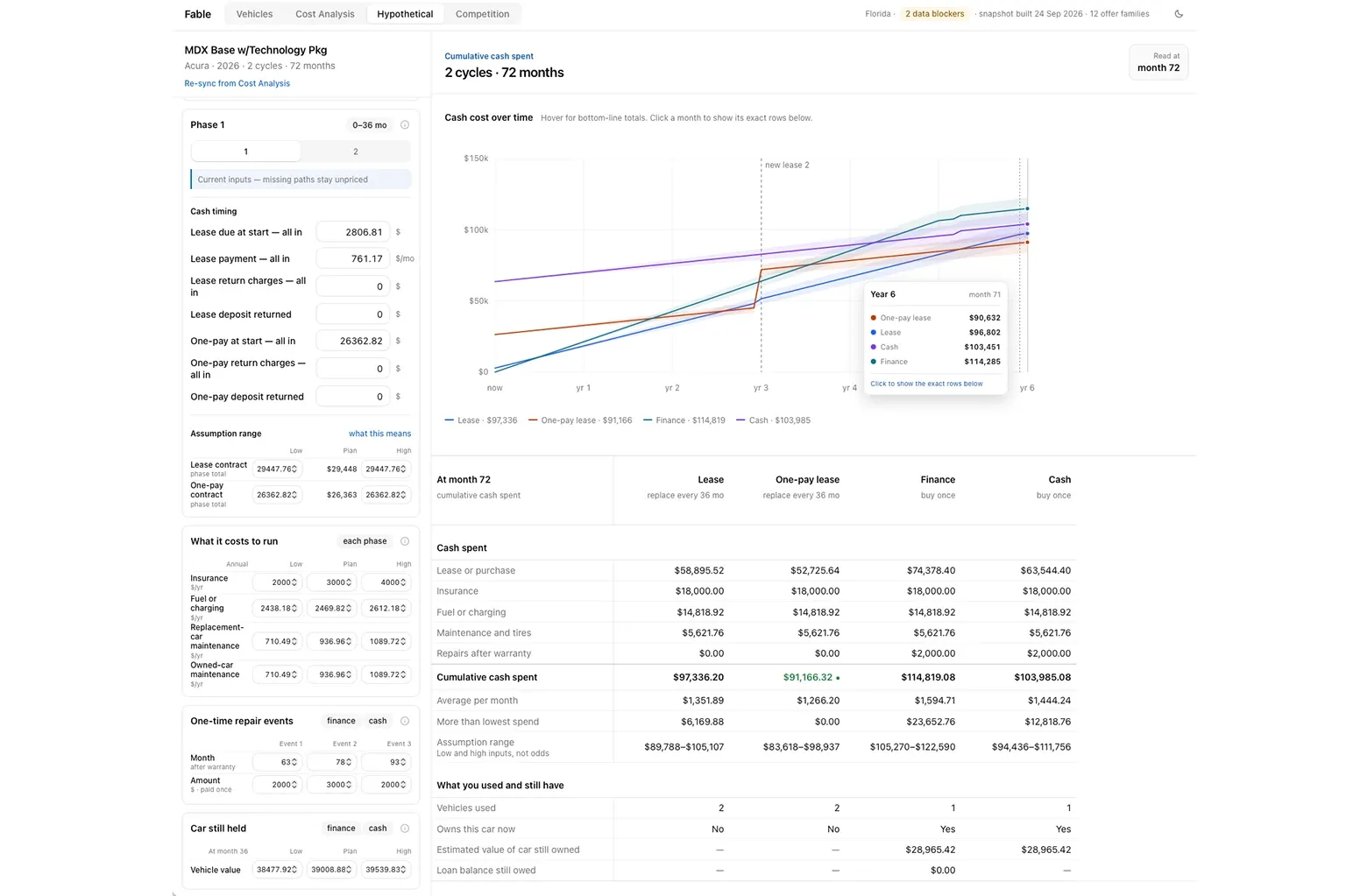
The premise, as you can see, is just to extend tabs one and two into what the cost might be over X time for a given finance option. That is, given the same data, might it be smarter to lease 2 cars over 6 years rather than buy with cash and try to sell one car at the end of 6 years? What would the costs be? What is the expected value of the car at the end of those 6 years? What about 9 years? How many large, unexpected events should we add? And so on.
But again, it’s just assumptions based on research. It is not likely that any current analysis will be valid for any numbers over any years. There are just too many variables. It is a conceptual min/max: if using the least capital to get the most car is the goal, how should you deploy it? Is it more important for the car to always be under warranty and have maintenance included, or is it more important to have a car you can fix yourself, then try to sell it in year 9 and use the proceeds to purchase a new car? Balancing current dollars against assumed outflows over time. It just depends on where that person is now and where they think they might be later on.
The Competition
OK, you have done some reading. Looked at some numbers. You go to look at cars in real life. Modern shopping requires modern solutions. Rather than rely on that kind salesman at the local dealer, you are going to reach out to every dealer. In the entire state. And you know what? You aren’t just interested in one car, but a few different cars from different manufacturers. And because you are hesitant to share your information with sketchy dealers and you don’t want spam, you decide to use a masked email, a unique email for every single dealer. And because you are token rich, you decide to loop in the robots. The marketing says they are the smartest on the planet and can solve everything. Can they solve real-world negotiations? Can they get the tone and copy right? Stay consistent across 40+ dealers and hundreds of different emails? Be a world-class negotiator while living across different contexts and agents?
Turns out, kinda.
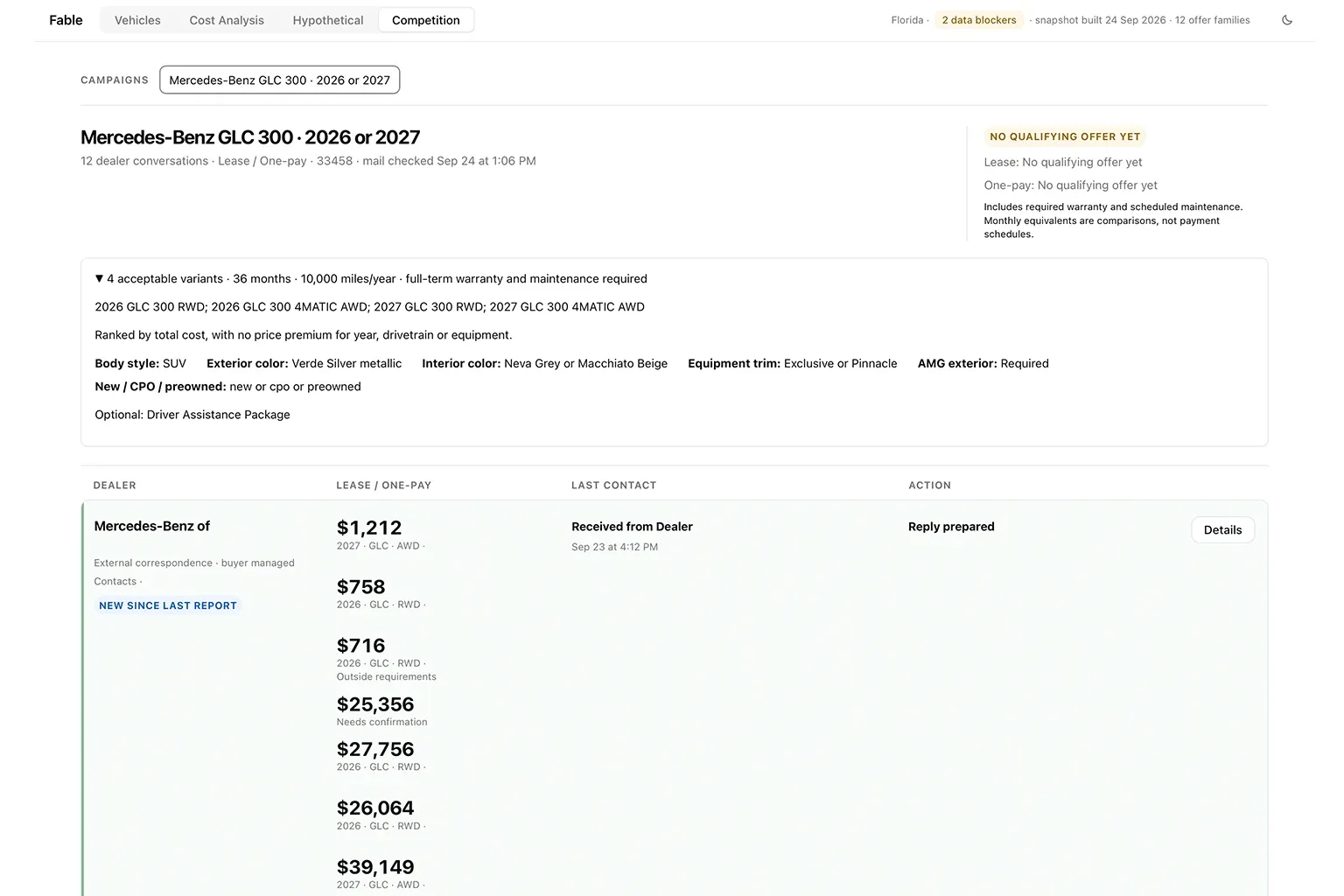
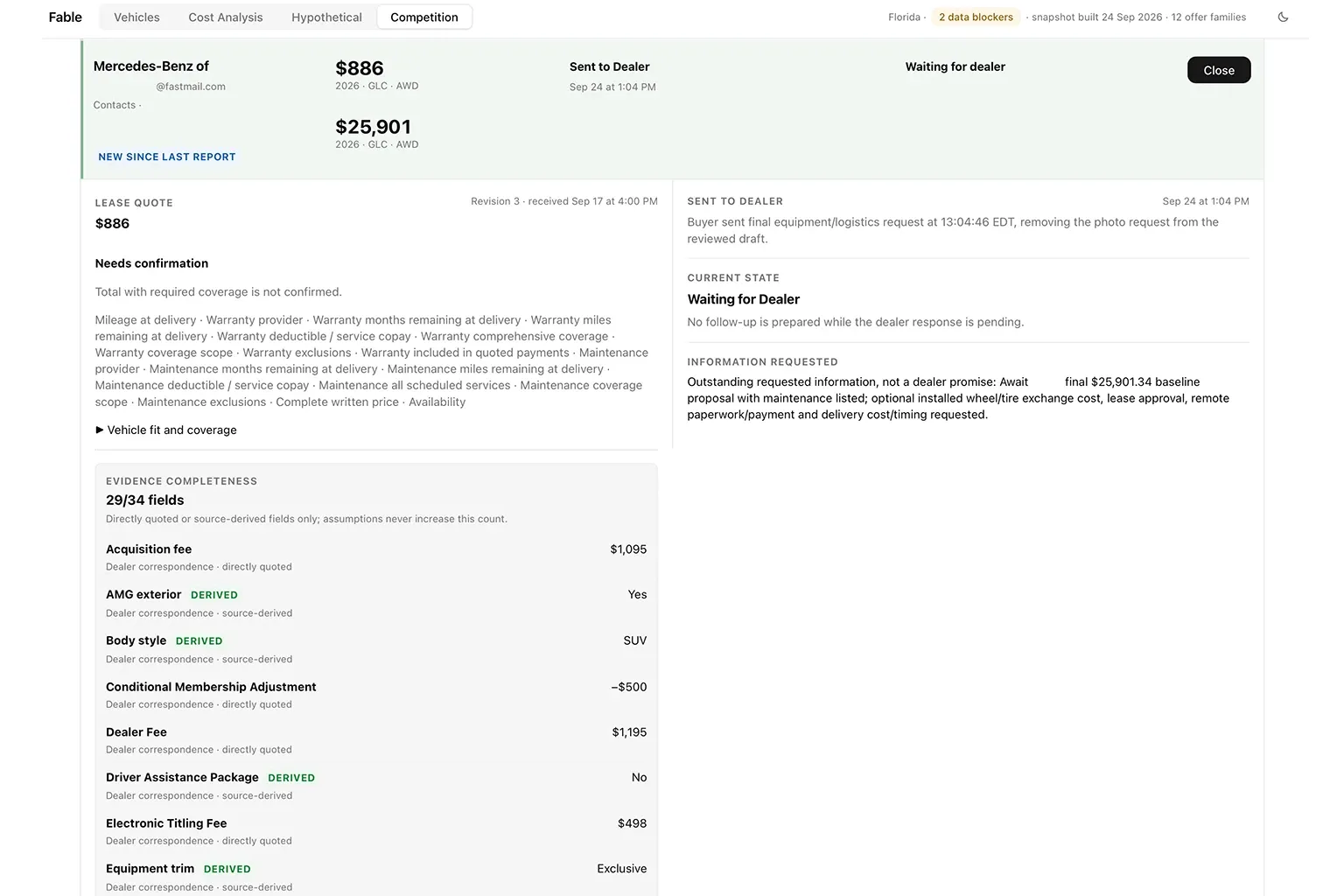
Parts of the above screenshots have been removed to hide sensitive data, but I think you get the rough idea (there is a LOT in the data accordions). Tab one got us comparable data. Tab 2 got us an analysis engine. Tab 3 got us longer-term thinking. They provided the base to build tab 4 for the agents and us to use side by side.
I set up a Fastmail account and the MCP (and logged into the internal web browser for each robot) so each could read and write emails. A SQL memory system was put in place so that every single piece of information was available offline and in a machine-readable format. A new agent could come in cold, understand the entire system—every email chain, every deal, every single detail—and then build a reply to any dealer at any step in the flow. Because real-world deals are messy—different cars with different options over time, different tones, different negotiation techniques, always shifting goalposts—the agents were always aware of the real goal: the best deal across the entire system. We built skills for each (Claude and Codex), and they changed over time, but generally they were good at staying aligned while absorbing a lot into their context for a singular specific task.
It helps that you can always iterate on the code and negotiation source references and copy quality as you go, but essentially, I had a super-smart partner who wasn’t emotionally invested. Let them take the heat; I’ll drive the overall picture. We had a local offline UI to see how the deals progressed, the emails in Fastmail, and the conversations with each AI agent. Everything went through multiple analysis engines—we could see where each dealer was trying to hide, or where others were honest and straight.
The only real issue was PDFs. Fastmail didn’t expose those via the MCP. But once the internal browsers were set up, they could see the PDF without downloading it.
The Story
Fable.html came from Claude. I asked it to name the HTML file, and it named it after itself. A little weird, but it felt right keeping it. We were telling stories in each tab. YMMV, depending on car availability, agent quality, and willingness to play the time game, but we ended up with good deals for multiple cars.
I am not sure this setup will work in the future. The near future feels like AI agents will be negotiating with AI agents. They hash it out, then your AI agent pays with their online wallet. I just tell my agent I want car X; they figure it out, and the car shows up the next day.
Or they finally solve self-driving, and a robot just takes you where you need to be when you need it.
Either way, new cars are here, and we have a few years to figure out the next version.
🚙🚕