Chapter Three - Compute & Light
The High End
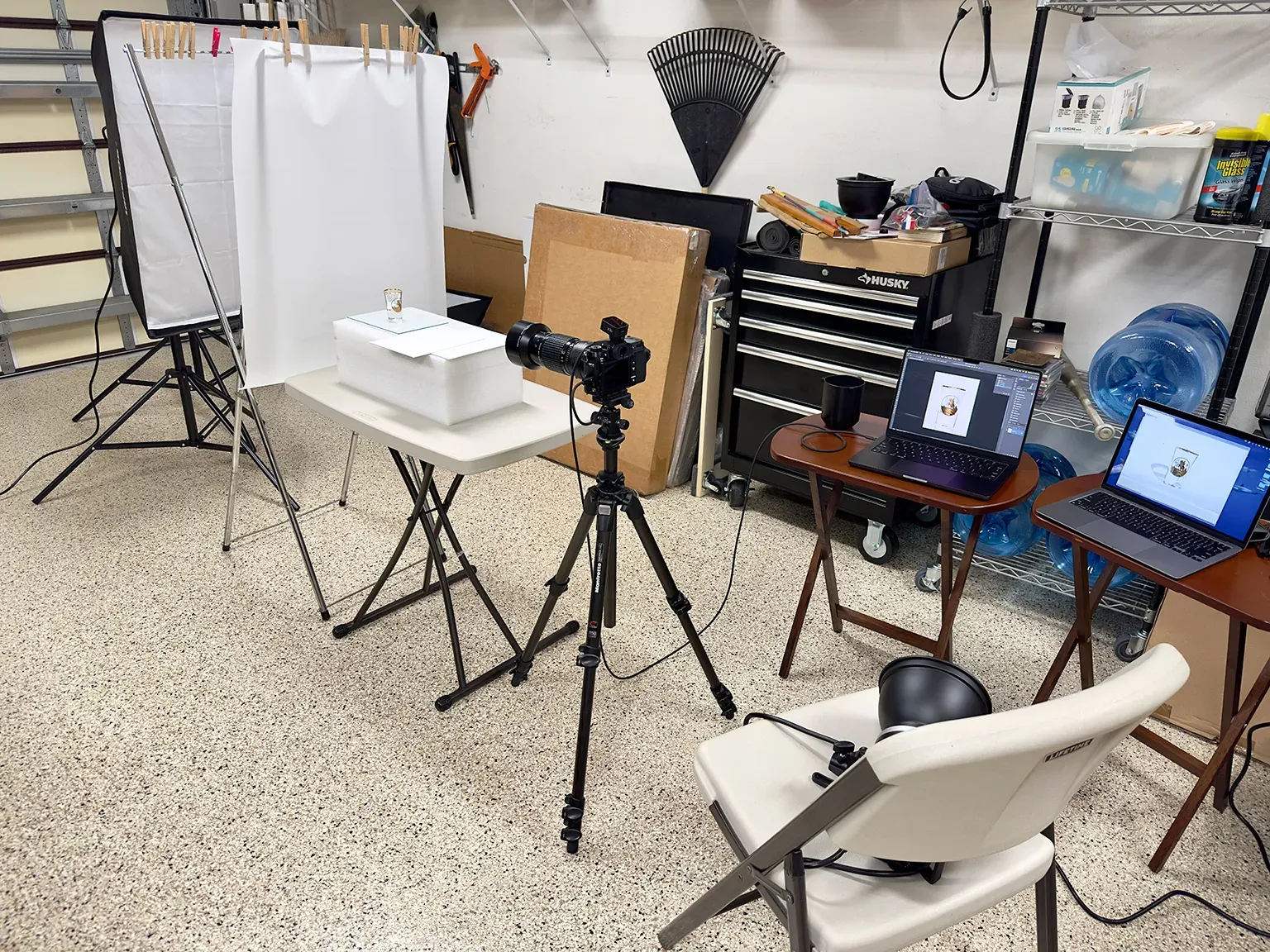
If you had the capital and the desire, you might purchase your glassware from Lalique, Moser, or Waterford. Their websites present the glass as art pieces. So I pondered, well, if this project is slowly turning into a coffee table book, I should find out how they produce their imagery and borrow some ideas. Which is how I ended up back in the garage where this whole project started. I needed more space. New soft boxes, strobes, diffusion material, stands, and acid-etched museum glass took up quite a bit of room. Sadly, the trusty side table did not make the transition, but still lives on in our hearts, and in the bedroom where it belonged.
You know what also started this journey with us, and is not well equipped to deal with 200mb raw files from a Fuji medium format camera? The M1 MacBook Air. Relegated to Spotify duty and imagery comparisons, it was superseded by the M4 MacBook Pro Max. And with the most expensive thunderbolt cable known to mankind, we have completed our transition from iPhone to mini photo studio.
The Flow
Each glass was cleaned, delinted, and photographed. All were quite different. Many received little bounce boards, or changes in front or back lighting, some even with polarized lenses or sheets on the strobes to improve the quality of the light through or bounced from the glass.
After capture, each image was fine-tuned in Capture One, followed by Photoshop. Each glass kept their damage and age, just small clean up here and there.
The Result
We now turn our attention to learning InDesign to make a coffee table book. Which surely won’t be that difficult? InDesign is known to be user friendly.